
How Does a Maltipoo Differ from a Maltese and a Toy Poodle? A Comparison for Those Looking to Choose
When people start searching for a small, intelligent and hypoallergenic dog, three breeds keep coming up again and again: the maltipoo, the Maltese and the toy poodle. They look similar on the surface but differ quite significantly in character. The confusion is understandable — all three are compact, beautiful and marketed as ideal apartment dogs. But the decision of which one to bring home comes down to specific details: how much grooming the coat actually requires, how strongly the dog bonds to one person, how it responds to children and strangers, and whether anyone in the household has allergies. In this article we break down the differences honestly and practically — no sales pitch, no vague generalisations. If you are already leaning towards a maltipoo, browse our puppy catalogue and read the article Maltipoo: Everything You Need to Know About the Breed Before Buying a Puppy — it covers a detailed portrait of the breed.
Where the maltipoo comes from — and why it matters
The Maltese and the toy poodle are established breeds with centuries of history and FCI standards behind them. The maltipoo is a hybrid — a deliberate cross between these two breeds. The combination was no accident: breeders were looking for a dog that would unite the gentle, affectionate character of the Maltese with the intelligence and low-shedding coat of the poodle. The result proved to be a success — so much so that the maltipoo is now one of the most popular designer hybrids in the world. Understanding this background matters for practical reasons: the maltipoo does not have a single fixed appearance or temperament standard the way a purebred does. Different generations and different parent combinations produce different results. That is precisely why choosing a responsible kennel with a transparent breeding approach is not a luxury but a necessity. For more on what F1 and F2 generations mean for a future owner, see the article Maltipoo F1 and F2: What Do These Designations Mean?
Appearance: similar but distinct
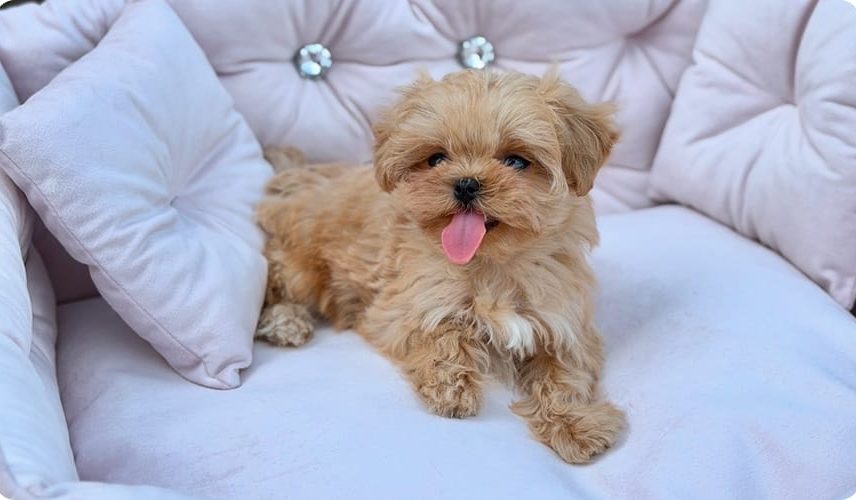
The Maltese is always a white dog with long silky hair that falls in smooth, even strands. The breed standard is strict: only white colouring, specific proportions, a distinctive head with round dark eyes. Adult Maltese typically weigh between 3 and 4 kilograms and have a delicate build. The toy poodle comes in a wide range of colours — black, white, apricot, chocolate, silver — and has a characteristic curly or wavy coat. A toy poodle stands up to 28 centimetres at the withers and weighs up to 4 kilograms. The maltipoo has no fixed standard — appearance depends entirely on which traits dominate in a given puppy. One puppy may look like a fluffy Maltese with gentle waves, while another closely resembles a miniature poodle with a slightly longer muzzle. Coat colour in maltipoos also varies widely: from pure white to cream, apricot, chocolate and even parti-colour combinations. This variety is one of the reasons maltipoos are so popular — each puppy is genuinely one of a kind.
Temperament: the most important difference for most families
The Maltese is a classic companion breed in the oldest sense of the word. It bonds to one person or one family, is deeply attached, tuned in to the owner’s mood and does not cope well with being left alone. A Maltese can be cautious around strangers and needs time to warm up to new people. With children, care is needed — the breed is delicate, dislikes rough play and can become frightened or defensively reactive if a child is too boisterous. The toy poodle is one of the most intelligent dogs in the world, and this is not an exaggeration. It learns commands with remarkable speed, thrives on tasks and performs beautifully in dog sports and formal training. That said, the toy poodle is somewhat less clingy than the Maltese — it enjoys interaction but is also capable of greater independence. With strangers, poodles are generally open and friendly, though much depends on early socialisation. The maltipoo combines traits from both parents, and the result tends to be well-balanced: deeply attached to its family, comfortable with a wide range of people, less wary of strangers than a purebred Maltese, and as quick to learn as a poodle. Most maltipoos do well with children, though size is an important consideration — very small puppies should not be around rough play with toddlers.
Comparing the three breeds: key parameters
🐾 Maltese
Weight: 3-4 kg
Coat: long, straight, white only
Shedding: minimal
Temperament: gentle, sensitive, bonded to one owner
With strangers: cautious, needs time
With children: care needed, dislikes rough play
Training: good, but emotionally sensitive
Breed status: FCI recognised
🐾 Toy Poodle
Weight: up to 4 kg
Coat: curly or wavy, many colours
Shedding: minimal
Temperament: active, highly intelligent, independent
With strangers: generally open and friendly
With children: well, an active play partner
Training: exceptional, one of the smartest breeds
Breed status: FCI recognised
🐾 Maltipoo
Weight: 1.4 to 6 kg (depends on size)
Coat: wavy or curly, many colours
Shedding: minimal or none
Temperament: affectionate, social, intelligent
With strangers: open, makes contact easily
With children: well, considering size
Training: excellent, eager and willing
Breed status: hybrid, not FCI recognised
Coat care: where the most work is
All three breeds require regular grooming — but there are meaningful differences. The Maltese, with its traditionally long coat, needs daily brushing and regular bathing to maintain its bright white appearance and prevent matting. The straight texture of the Maltese coat does tangle somewhat less readily than a curly one. The toy poodle has a dense curly coat that does not shed and barely appears on furniture — but it grows continuously and needs professional trimming every four to six weeks. The curly texture is prone to tight mats in harder-to-reach areas if brushing is skipped for a few days. The maltipoo inherits coat characteristics from both parents: in most puppies the coat is wavy or lightly curly, sheds minimally or not at all, and also needs daily brushing and a grooming appointment every four to eight weeks. One practical detail worth noting: the wavy maltipoo coat generally responds more easily to home brushing than the dense curly coat of the toy poodle. In any case, grooming is a serious ongoing commitment with all three breeds. For a detailed breakdown of daily routines, see the article Maltipoo Care Details: A Practical Guide for New Owners.
Hypoallergenic qualities: the truth and the nuance
No dog is completely hypoallergenic — allergic reactions in people are triggered not by the hair itself but by the protein Can f 1, which is present in saliva, skin secretions and urine. However, breeds that shed very little release far fewer airborne allergens, which is where all three of our breeds hold an advantage over typical shedding dogs. The Maltese and the toy poodle have long been known as breeds that suit people with mild sensitivity to dog allergens. The maltipoo inherits this quality from both parents, and with the right choice of generation — particularly F1B and beyond, where the proportion of poodle genetics is higher — it can produce even fewer reactions. If anyone in the household has allergies, we always recommend a practical test: spend time with the specific puppy or adult dog before making a final decision. General guidance will never replace an individual’s personal response.
Training and intelligence: who learns fastest
The toy poodle ranks second in Stanley Coren’s classic canine intelligence rankings — right behind the border collie. This is not just a flattering label: toy poodles genuinely learn commands with impressive speed, understand tasks intuitively and can execute complex sequences of actions. They do need regular mental stimulation, though — without it they get bored and tend to find their own entertainment, which is not always what their owner had in mind. The Maltese also learns well, but it is more emotionally sensitive and finely attuned to the tone of a person’s voice and mood. A sharp tone or impatience can shut a Maltese down in a training session in a way that is not easy to recover from quickly. The maltipoo combines solid intelligence with a soft, flexible temperament — it learns willingly, responds well to positive reinforcement and rarely pushes back when training is structured thoughtfully. For most families this is an ideal balance: smart enough to pick up household rules quickly, and gentle enough that the process does not become a battle of wills.
Health and lifespan
The Maltese and the toy poodle, as purebred dogs, have well-documented breed-specific health tendencies. In Maltese, these include a predisposition to dental problems, tear staining and coat discolouration around the eyes, and a sensitive digestive system. In toy poodles, the main concerns are patellar luxation, progressive retinal atrophy and certain endocrine disorders. Both breeds typically live 12 to 15 years with proper care. The maltipoo, as a hybrid, potentially benefits from what is known as hybrid vigour — the phenomenon where crossing two distinct genetic lines reduces the likelihood of inheriting the specific diseases associated with each parent breed. In practice, this means that a well-bred maltipoo from health-tested parents may be more robust than either parent breed on its own. The key word is well-bred: this benefit only materialises when the breeder genuinely screens parent dogs for heritable conditions, rather than simply pairing any available Maltese and poodle for commercial purposes.
Size: the maltipoo offers more options
The Maltese and the toy poodle both fall within relatively fixed size ranges defined by their breed standards. A Maltese weighs 3 to 4 kilograms; a toy poodle stands up to 28 centimetres at the withers and weighs up to 4 kilograms. The maltipoo offers a significantly broader range: from Super Micro puppies around 1.4 kilograms up to standard-sized dogs of 6 kilograms. This makes it possible to select a size that genuinely fits your circumstances — whether there are young children in the home, whether travel is a regular part of life, or whether the living space has specific practical constraints. Choosing the right size is a separate topic in its own right, and we cover it in detail in the article Which Maltipoo size to choose: Super Micro, Micro, Mini, or Standard? — with specific recommendations for which sizes suit which situations best.
Papers and breed status: what it means in practice
The Maltese and the toy poodle are FCI-recognised breeds. When you purchase a purebred dog, you can receive a pedigree confirming lineage and enabling registration with kennel clubs, participation in shows and involvement in breeding programmes. The maltipoo, as a hybrid, does not have an FCI pedigree — this is a technical reality that simply needs to be accepted. However, a responsible kennel will provide a complete set of veterinary documentation: a veterinary passport with vaccination records, a health certificate and, where needed for international travel, EU-standard documentation. At MilaPoo Family we prepare the full documentation package required for legal travel with a pet within the European Union. For more detail, see our Documents page.
Which breed suits whom: practical guidance
The Maltese is a strong choice for someone who wants a classic breed with a predictable temperament, leads a relatively calm life and is prepared to give the dog a great deal of personal attention. A Maltese will be genuinely content alongside one or two close people, in a stable home without frequent changes of environment or a constant flow of visitors. The toy poodle suits those for whom outstanding intelligence is a priority — people who want to actively train their dog, teach it complex tasks, engage in dog sports or build a rich working relationship through structured activity. If you want more than a companion and are drawn to the process of training itself, the poodle is a very worthy choice. The maltipoo is the most versatile of the three for households where different people are involved: children, regular guests, an active daily rhythm. It is social enough to adapt easily to varied situations, smart enough to learn household rules quickly and affectionate enough to be a genuine everyday companion. Among our clients are young couples, retirees, families with children and people living on their own. The maltipoo fits into a remarkably wide range of lives — and that adaptability is its defining strength.
How we approach breeding at MilaPoo Family
We have been working with maltipoos since 2018 and were among the first kennels dedicated to this breed in Ukraine. Over the years we have developed a clear understanding of which parent pairings consistently produce the results we are looking for: a stable temperament, a coat that suits its owner’s lifestyle and solid health. Every puppy with us receives a veterinary check, vaccinations and socialisation before moving to its new family. We are not selling a beautiful image — we are raising a dog that will live harmoniously alongside you for years. If you have questions about choosing between a maltipoo and another breed, or would like to get to know our current puppies, reach out through our Contacts page. Answers to the most common questions are on our FAQ page.
Frequently asked questions
Maltipoo or Maltese: which breed is calmer?
The Maltese is generally the calmer and less active of the two — more of a lap companion that is content with shorter walks and longer rest periods. The maltipoo is more curious and energetic thanks to its poodle heritage, but it still falls firmly in the moderately active category and does very well in an apartment. If you want the quietest possible dog, the Maltese is the better fit. If you want a dog that is lively without being exhausting, the maltipoo is the answer.
Is there a real difference in grooming between a maltipoo and a toy poodle?
Both breeds need regular grooming, but the coat texture differs in ways that matter day to day. The toy poodle’s curly coat is denser and more prone to matting in awkward spots — under the armpits, behind the ears, between the toes. The maltipoo coat is typically softer and wavier, and tends to be a bit more manageable for at-home brushing. Both breeds need a professional groom every four to eight weeks.
Why does a maltipoo from a good kennel cost as much as a purebred?
Responsible hybrid breeding requires no less investment than breeding a recognised purebred: health testing of parent dogs, veterinary care throughout the litter, thorough socialisation of puppies and a complete documentation package. A notably low price on a maltipoo is almost always a sign that one or more of these steps has been skipped. The cost reflects the work — or the absence of it.
Is a maltipoo better for a family with allergies than a Maltese or poodle?
All three breeds produce fewer airborne allergens than shedding dogs. A maltipoo with a higher proportion of poodle genetics — F1B or F2B generation — may trigger even fewer reactions thanks to a denser, curlier coat that holds more dander close to the body rather than releasing it into the air. That said, the only reliable way to assess compatibility is personal contact with the specific dog, since individual sensitivity always takes precedence over general recommendations.
Daily tips and live photos of our puppies are on Instagram. Behind-the-scenes moments and new puppy announcements are in our Telegram channel.