
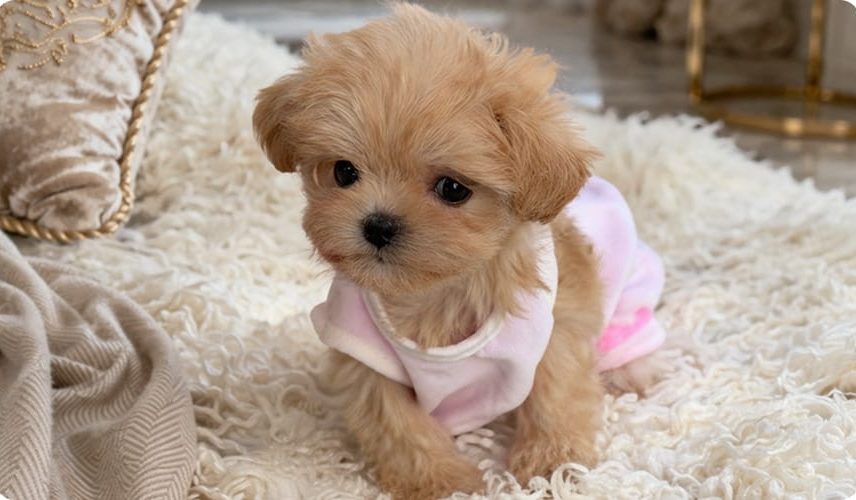
Leaving your Maltipoo home alone: how to prevent separation anxiety
Maltipoos are built for closeness with people. They read moods intuitively, settle into the rhythm of a household quickly and genuinely light up when their owner comes home. This attachment is exactly what makes the breed so special, but it can also be the source of anxiety when you leave. Separation anxiety in a maltipoo is not a behavioural flaw or poor training. It is a nervous system response to the sudden absence of the person a dog trusts most. The good news is that with the right approach, independence builds gradually and without stress for either side. If you are still choosing a puppy, browse our puppy catalogue, where you will find videos in motion and short personality descriptions for every puppy.
How to recognise separation anxiety
Not every whine or bark signals separation anxiety, but there are signs worth noticing. The dog begins to show stress before you even leave: following you from room to room, whining at the door, refusing to settle on its bed. After you leave, it barks or howls for a prolonged period, chews belongings, scratches at doors, or refuses food and water. On your return, it stays highly excited and takes a long time to calm down. If these signs repeat regularly, it is time to work on independence in a structured way.
Why maltipoos find being alone difficult
Maltipoos are companion dogs in the truest sense. The breed was developed to stay close to people, and this is written into their character at a genetic level. Add a sensitive nervous system and a natural ability to read human emotions, and it becomes clear why solitude is harder for them than for more independent breeds. This is not a weakness — it is a trait that can and should be worked with.
The core principle: gradual progress
The most common mistake is leaving a puppy alone for several hours from the very first week and waiting for it to “get used to it”. A puppy’s nervous system does not work that way. Instead of adapting, stress accumulates and eventually becomes a fixed reaction to the owner’s departure. The right path is short, predictable absences that increase slowly over time. The dog needs to learn one thing: the person leaves, but always comes back.
A step-by-step plan for building independence
Step 1. Create a safe place
A bed or crate is not a punishment — it is the dog’s personal space. Introduce it gradually: place a favourite toy inside, a portion of food, a blanket with a familiar scent. Let the dog go in on its own terms, without any pressure. Once the space is associated with calm and safety, it becomes an anchor during your absence.
Step 2. Practise short separations at home
Before you start leaving the flat, practise pauses in contact inside. Close the door to the next room for one or two minutes. Return calmly, without making a fuss. Gradually extend the time to 5, 10 and then 15 minutes. This gives the dog the lived experience that separations are short and end with a reunion.
Step 3. Leave without drama
Getting ready to go out should not turn into a farewell ritual. Long hugs, a sorrowful tone of voice and lingering at the door all heighten anxiety. It is better to get ready in advance, give the dog a chew toy or a lick mat, and leave calmly without stopping. Keep your return low-key too: greet the dog once it has settled, not at the peak of excitement.
Step 4. Leave something to do
Boredom amplifies anxiety. Before leaving, give your maltipoo something to keep it occupied: a frozen lick mat, a chew snack or a food puzzle. This redirects attention and gives the nervous system a gentle way to settle. Rotate toys regularly so they stay interesting and retain their value.
Step 5. Increase time gradually
Move from 5 minutes to 30, from 30 to an hour, from an hour to two. Do not rush to the next stage until the current one is consistently calm. If anxiety returns after an increase, step back and consolidate the shorter intervals before moving forward again.
What helps while you are away
Background sound — quiet music or a radio at low volume — reduces the sense of emptiness in the flat. A blanket or a worn piece of your clothing on the dog’s bed provides a sense of your presence. A monitoring camera helps you see what is actually happening in your absence and adjust your approach accordingly. Some owners use interactive cameras with two-way audio, but use this with care: a voice without a physical presence can sometimes excite more than it soothes.
Common mistakes to avoid
Punishing for chewed belongings
A dog chews things out of stress, not spite. Punishment after you return home is not connected in the dog’s mind to something that happened an hour ago. It only adds more anxiety and makes the situation worse.
Picking the dog up every time it whines
If every whine ends in cuddles, the dog quickly learns that whining works. It is better to wait for a moment of quiet and then approach and reward the calm.
Jumping too quickly to long absences
Leaping from 20 minutes to 5 hours is a significant shock to the nervous system. Gradual progress matters far more than speed here.
Ignoring signs of stress
If the dog is trembling, refusing food, or showing obvious signs of severe distress every time you leave, this is a reason to consult an animal behaviour specialist rather than waiting for it to resolve on its own.
How long can a maltipoo be left alone
A healthy adult dog with a well-developed sense of independence can comfortably be left alone for up to 4 to 6 hours. For puppies under 6 months, this time is considerably shorter, and their need for toilet breaks also needs to be factored in. If your schedule involves long absences, it is worth arranging support: a dog sitter, a family member or a neighbour who can drop in during the day. This eases the load for both the dog and for you.
How we at MilaPoo Family prepare puppies for independence
We start working on independence from the very first weeks. Puppies are introduced to their bed and crate, practise short pauses without human contact and gradually build experience of calm waiting. By the time of the move, a puppy already has a foundation: a place associated with safety, an established daily rhythm and early experience of short separations. This makes adaptation in a new home considerably smoother. If you have questions about preparing for independence or the adaptation process, feel free to get in touch. All our contact details are on the Contacts page.
Frequently asked questions
At what age can a maltipoo be left alone?
The first short pauses can begin as early as 2 to 3 months, but should not exceed 30 to 40 minutes. Gradually increase the time as the puppy grows and the skill develops.
Does getting a second dog help?
Sometimes, but not always. If the first dog has pronounced separation anxiety, the second may adopt the same behaviour. It is better to work on the first dog’s independence before considering a companion.
Is a monitoring camera worth it?
Yes, it is a useful tool. A camera helps you see the real picture and track whether there is progress. Just try not to turn watching into a source of your own anxiety: if you are constantly checking and worrying, it does not help either of you.
When should I consult a specialist?
If after several weeks of consistent work the situation is not improving, or the dog is showing severe stress responses such as trembling, refusing food or self-injury, it is time to consult a professional dog trainer or a veterinary behaviourist.
Daily tips and live photos of our puppies are on Instagram. Behind-the-scenes moments and new puppy announcements are in our Telegram channel.